
01
In-ear voice capture
Voice audio is captured from within the ear canal, avoiding the acoustic chaos of the MRI environment.
The precision required to achieve clear imaging in the MRI environment can be a complex and unpredictable process to navigate. High levels of acoustic output leads to diminished communication capabilities during procedures where collaboration between medical staff and patients has proven essential. EERS offers a solution for the future of MRI communication: reliable, clear 2-way audio technology developed for safe use in and around the MRI bore.
Partnered & validated with
Technology
EERS enables clinicians and patients to communicate clearly inside the MRI bore in real time, during active scanning, without compromising image quality.
Direct Ear Link (DEL)
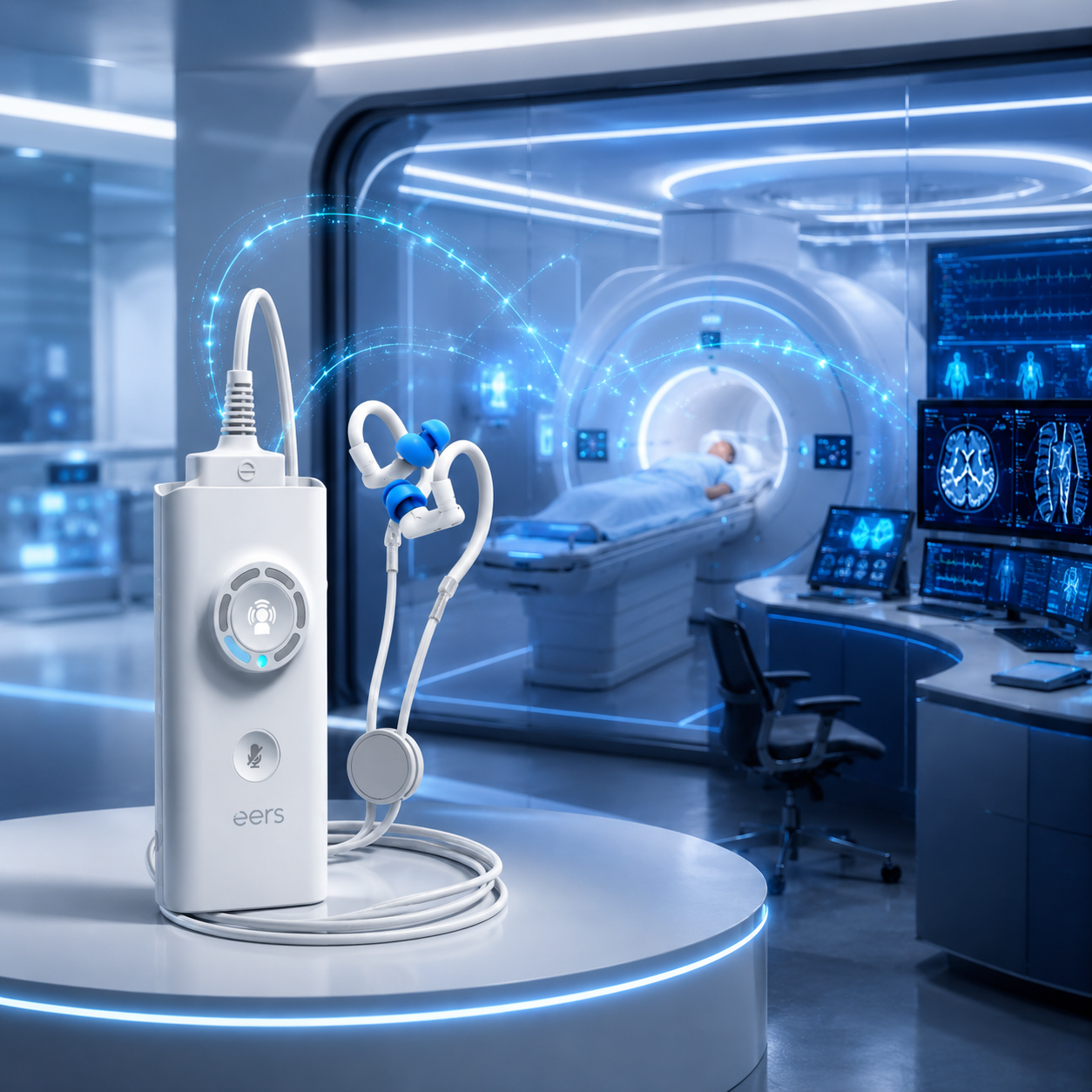
EERS captures voice directly from the inner ear canal for precise, reliable two-way communication with integrated hearing protection, enabling fast, clear exchanges between patients, technologists, and staff during MRI workflows.
Voice audio is captured from within the ear canal, avoiding the acoustic chaos of the MRI environment.
Cutting-edge models minimize unnecessary abrasive noise from inside and around the MRI bore.
Captures and reconstructs voice audio for clean, reliable communication even above 100 dBA.
Using EERS does not compromise MRI image integrity or reliability.
Connects with existing MRI systems via API for quick integration with OEMs and hospital AV stacks.
The result: EERS delivers cutting-edge two-way communication in and around the MRI suite, one of the most audibly challenging environments in medicine.
Solutions
EERS supports multiple MRI workflows across clinical environments, from research suites to high-throughput imaging networks.
 Interventional MRI
Aiming to add a new level of clear communication for MRI-guided procedures, biopsies, cardiac interventions, and ablations where clinician-to-clinician and clinician-to-patient communication is critical.
Learn more Remote MRI
Integrates with existing KVM solutions to connect off-site technologists directly with patients inside the scanner, supporting distributed imaging networks.
Learn more Diagnostic MRI
Supporting real-time instruction between clinicians and patients during diagnostic MRI procedures can improve patient comfort and help support a collaborative effort towards clear imaging and to minimize repeat scans.
Learn moreInterventional MRI
Interventional MRIInterventional MRI procedures require precise coordination between clinicians, technologists, and patients. In and around the MRI bore, extreme acoustic noise makes clear and reliable communication difficult.
Over time, clinicians have been resourceful in developing their individual techniques to help overcome this communication barrier, often relying on hand signals, repeated scan pauses, or indirect communication through technologists outside the scanner room. EERS aims to relieve that burden by giving the MRI suite a new voice: a clear and dependable two-way communication system.
Traditional MRI communication systems deliver sound to the patient, but cannot capture voice clearly from inside the scanner. EERS is the only system designed to capture, filter, and reconstruct voice directly from the ear canal, enabling true two-way communication in and around the MRI bore.
Powered by patented technology, and backed by years of research and development, EERS is proud to introduce a new communication standard into the MRI environment. Built to aid the efficiency and precision of interventional procedures: Cardiac Interventional MRI, Biopsy Procedures, and Ablation Treatments.
EERS aims to minimize
Slowing down procedures
Interruptions and unclear coordination extend procedure times and reduce throughput.
Patient stress & anxiety
Isolation and extreme noise inside the bore heighten patient distress during interventions.
Interrupting workflow
Technologists must pause scans or relay messages indirectly, breaking clinical focus.
Limiting scope
The range of interventional procedures performed is constrained when communication is unreliable.
As interventional MRI continues to expand into new clinical areas, reliable communication is more essential than ever before. MRI-guided interventions continue to grow across cardiology, oncology, and minimally invasive treatments. As these procedures evolve, reliable communication inside the MRI bore will become an integral part of the infrastructure. EERS enables clinicians to communicate clearly during procedures, unlocking new possibilities for MRI-guided medicine.
Remote MRI
Remote MRIRemote MRI allows technologists to operate scanners from centralized locations, addressing the growing shortage of MRI technologists and improving access to imaging services. But communication inside the MRI environment remains a major challenge.
Remote operators often rely on indirect communication through on-site assistants or limited audio systems that cannot clearly capture patient responses. Patients may not hear instructions clearly, operators cannot confirm patient responses reliably, workflow interruptions slow the scanning process, and communication errors increase clinical risk.
EERS enables clear two-way voice communication between remote operators and patients inside the MRI environment while integrating with existing and emerging remote MRI platforms and imaging technology providers. These systems enable technologists to remotely operate scanners, monitor patient status, and manage imaging workflows.
Improved Patient Safety
Clear instructions and responses reduce clinical risk.
Workflow Efficiency
Operators can communicate without pausing scans or relying on intermediaries.
Better Patient Experience
Patients feel reassured when they can clearly hear and respond to instructions.
Scalable Remote Operations
Reliable communication enables healthcare systems to expand remote MRI programs confidently.
As remote MRI continues to expand globally, reliable communication between operators and patients becomes essential, and EERS can help.
Diagnostic MRI
Diagnostic MRIDiagnostic MRI represents the largest segment of the MRI imaging ecosystem. With more than 100 million scans performed annually, even small improvements in workflow efficiency or patient experience could have significant impact. As imaging centers look for ways to improve patient satisfaction and reduce scan interruptions, reliable communication inside the MRI bore becomes increasingly valuable.
During a diagnostic MRI, patients are often isolated inside the scanner with minimal ability to communicate with technologists. Instructions may be difficult to hear, and patients may struggle to respond clearly if they become uncomfortable or anxious.
Improving communication inside the scanner could significantly improve the patient experience, reduce scan times and minimize repeat imaging due to movement.
EERS aims to minimize
Patient anxiety
Isolation and scanner noise heighten stress, especially for first-time and pediatric patients.
Repeat scans
Movement from unclear instructions leads to retakes and longer appointments.
Longer scan times
Limited back-and-forth slows down the workflow for technologists and patients alike.
Sedation reliance
Pediatric and claustrophobic patients often require sedation that better communication may reduce.
EERS is working with clinical partners and research institutions to explore how improved communication inside MRI environments can support new clinical workflows and improve patient outcomes, with active research into sedation reduction and enhanced patient interaction during imaging.
Looking ahead
EERS opens the door to several emerging applications in diagnostic MRI environments.
Sedation reduction in pediatric imaging
Improved communication may help reduce the need for sedation in younger patients.
Caregiver presence model
Family reassurance through real-time voice can support comfort during scans.
Task-based imaging
Clear, two-way instructions can support brain mapping and functional imaging procedures.
Advanced patient monitoring
Future capabilities may include feedback, hearing support, and therapeutic audio inside the bore.
Better communication. Better experience. Better outcomes.
Company
EERS is building the communication infrastructure that enables clinicians and patients to hear and be heard inside the MRI environment, because no patient should face a scan alone, and no clinician should work without a voice.
Our Mission
MRI technology has transformed medical imaging and enabled new forms of diagnosis and treatment. Yet one fundamental challenge has remained largely unchanged: voice communication in and around the scanner.
EERS exists to solve this problem.
Our mission is to enable clear, reliable communication in the most acoustically challenging environment in medicine, helping clinicians perform procedures with greater confidence while improving the patient experience during imaging.
By combining advanced audio engineering, machine learning, signal processing, and MRI-safe hardware, EERS is building the communication layer for the next generation of MRI workflows.
Meet our team
The EERS team brings together expertise in audio, embedded software, electrical engineering, and healthcare innovation.
The company's technology builds on years of research in advanced signal processing, machine learning, noise filtering, and speech reconstruction.
Team members and advisors bring experience from leading technology and healthcare organizations, helping guide the development of communication technology specifically designed for MRI environments.

Nick Laperle
CEO

Michael Tooker
COO/CTO

Justin Heroux
CFO

Thomas Biela
VP Commercialization

Dr. Anish Kirpalani
Clinical Strategy Partner
Experience EERS
Experience how EERS enables clear communication in the most challenging clinical environments.